

Semiconductor Process Chemicals Market Forecast 2026–2036: Market to Reach USD 57.1 Billion by 2036 at 11.80% CAGR
Rising advanced node complexity, fab localization, and ultra-high-purity requirements accelerate long-term market expansion
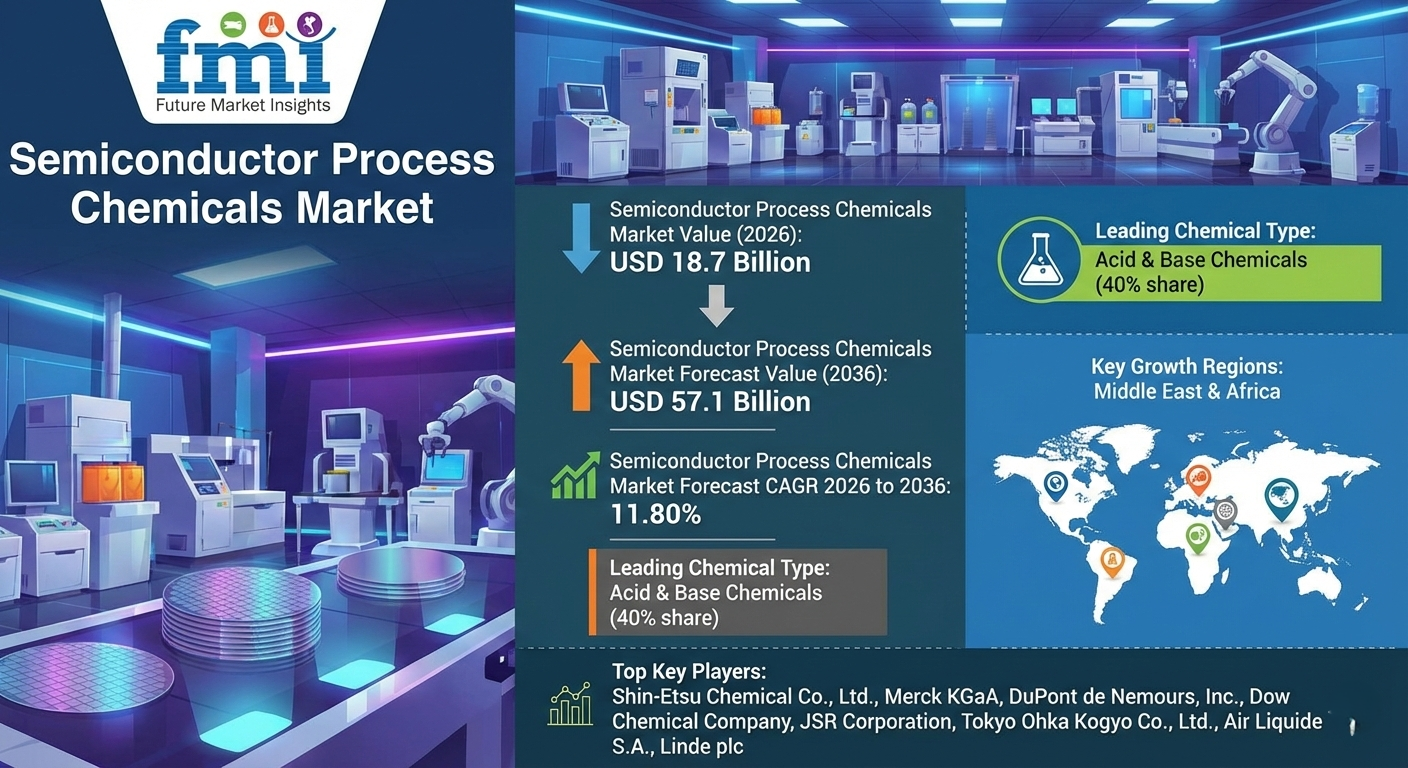
NEWARK, DE, UNITED STATES, February 24, 2026 /EINPresswire.com/ -- The global Semiconductor Process Chemicals Market is valued at USD 18.7 billion in 2026 and is projected to reach USD 57.1 billion by 2036, expanding at a CAGR of 11.80% from 2026 to 2036. Growth is driven by advanced node scaling, rising wafer complexity, and increasing process steps per wafer across logic, memory, and power semiconductor fabrication.
As semiconductor manufacturing shifts toward sub-5 nm nodes, 3D architectures, and EUV lithography, process chemicals are evolving from supporting materials into yield-critical inputs—directly influencing device performance, defect density, and fab uptime. Unlike cyclical capital equipment spending, semiconductor process chemicals generate structurally recurring demand, tied closely to wafer starts and capacity utilization rates across global fabrication clusters.
Semiconductor Process Chemicals Market Snapshot (2026–2036)
• Market size in 2026: USD 18.7 Billion
• Market size in 2036: USD 57.1 Billion
• CAGR (2026–2036): 11.80%
• Leading chemical type: Acid & Base Chemicals (40% share)
• Largest application segment: Cleaning & Surface Preparation (30% share)
• Fastest-growing country: China (13.2% CAGR)
• Key companies: Shin-Etsu Chemical Co., Ltd., Merck KGaA, DuPont de Nemours, Inc., Dow Chemical Company, JSR Corporation, Tokyo Ohka Kogyo Co., Ltd., Air Liquide S.A., Linde plc
Market Momentum
The Semiconductor Process Chemicals Market begins at USD 18.7 billion in 2026, supported by sustained global wafer fabrication activity and advanced node migration. Between 2026 and 2030, fab expansions across Asia Pacific and North America, alongside memory and logic scaling, drive incremental chemical intensity per wafer.
Entering 2030–2034, next-generation lithography, high-aspect-ratio etching, and 3D device structures increase demand for ultra-high-purity wet chemicals, advanced photoresists, CMP slurries, and specialty gases. By 2036, the market reaches USD 57.1 billion, with growth increasingly driven by value density, co-development partnerships, and qualification-intensive specialty formulations rather than volume alone.
Request For Sample Report | Customize Report |purchase Full Report - https://www.futuremarketinsights.com/reports/sample/rep-gb-31294
Segment Spotlight
1. Chemical Type: Acid & Base Chemicals Lead Demand
Acid and base chemicals account for approximately 40% of total market share. Materials such as hydrofluoric acid, sulfuric acid, and ammonium hydroxide are used repeatedly across cleaning, etching, and surface preparation stages. Their recurring use and volume intensity make them foundational to semiconductor fabrication workflows.
2. Application: Cleaning & Surface Preparation Dominates
Cleaning and surface preparation represent nearly 30% of application demand. As device geometries shrink, even microscopic contamination can cause yield loss. Multiple wet cleaning cycles between lithography, etching, and deposition processes drive stable and recurring consumption patterns.
3. Specialty Materials: Photoresists and CMP Slurries Gain Value Share
Although lower in volume compared to acids and bases, specialty photoresists and CMP slurries command high value due to node-specific customization, qualification depth, and direct impact on patterning accuracy and planarization performance.
Drivers, Opportunities, Trends, Challenges
Drivers:
• Advanced node scaling and wafer complexity
• Fab capacity expansion and localization
• Recurring demand tied to wafer starts
Opportunities:
• Co-development partnerships with leading fabs
• Localization of chemical production near fabrication clusters
• High-purity and defect-reduction innovations
Trends:
• EUV-specific photoresist development
• Ultra-low metallic impurity formulations
• Increased integration with digital process control systems
Challenges:
• Long qualification timelines
• Stringent contamination thresholds
• Supply chain concentration risks
• Margin pressure from large IDMs and foundries
Country Growth Outlook (2026–2036)
China leads growth at a projected 13.2% CAGR, supported by aggressive domestic fab build-outs and localization initiatives. Taiwan follows at 12.8%, driven by advanced foundry dominance and sub-5 nm production. South Korea expands at 12.4% amid strong DRAM and NAND output. The United States grows at 11.6%, supported by strategic investments in advanced logic and power semiconductor facilities, while Japan records steady 11.2% growth through specialty chemical leadership and high-performance material innovation.
Asia Pacific remains the primary volume engine, while North America and Japan emphasize value-intensive, specification-driven applications.
Competitive Landscape
Competition in the Semiconductor Process Chemicals Market centers on purity control, batch consistency, and node compatibility.
Shin-Etsu Chemical Co., Ltd. and JSR Corporation lead in advanced photoresists and lithography-critical materials tailored for EUV and advanced DUV processes. Tokyo Ohka Kogyo Co., Ltd. strengthens its market position through precision patterning chemistries with tight sensitivity control.
Dow Chemical Company and DuPont de Nemours, Inc. compete through broad portfolios of cleaners, developers, and etchants engineered for yield stability. Merck KGaA differentiates through CMP slurries and wet chemicals supported by traceability and contamination control systems.
In process gases and specialty delivery systems, Air Liquide S.A. and Linde plc emphasize ultra-high-purity supply and uninterrupted fab operations. Competitive advantage increasingly depends on long-term supply agreements, near-fab production facilities, and co-development with leading semiconductor manufacturers.
Frequently Asked Questions (FAQ)
What is the global Semiconductor Process Chemicals Market size?
The market is valued at USD 18.7 billion in 2026 and is projected to reach USD 57.1 billion by 2036.
At what rate is the market expected to grow?
The market is forecast to expand at a CAGR of 11.80% from 2026 to 2036.
Which chemical type leads the market?
Acid and base chemicals lead with approximately 40% market share due to recurring usage across fabrication stages.
Why are semiconductor process chemicals critical?
They directly influence wafer cleanliness, pattern fidelity, yield stability, and device performance, making them indispensable across all front-end semiconductor manufacturing processes.
Explore More Related Studies Published by FMI Research:
Boiler Water Treatment Chemicals Market https://www.futuremarketinsights.com/reports/boiler-water-treatment-chemicals-market
Alunite Market https://www.futuremarketinsights.com/reports/alunite-market
3D Printing Metal Market https://www.futuremarketinsights.com/reports/3d-printing-metal-market
About Future Market Insights (FMI)
Fture Market Insights, Inc. (FMI) is an ESOMAR-certified, ISO 9001:2015 market research and consulting organization, trusted by Fortune 500 clients and global enterprises. With operations in the U.S., UK, India, and Dubai, FMI provides data-backed insights and strategic intelligence across 30+ industries and 1200 markets worldwide.
Why Choose FMI: https://www.futuremarketinsights.com/why-fmi
Sudip Saha
Future Market Insights Inc.
+1 347-918-3531
rahul.singh@futuremarketinsights.com
Legal Disclaimer:
EIN Presswire provides this news content "as is" without warranty of any kind. We do not accept any responsibility or liability for the accuracy, content, images, videos, licenses, completeness, legality, or reliability of the information contained in this article. If you have any complaints or copyright issues related to this article, kindly contact the author above.
