

Global Renewable Naphtha Industry Report: Pricing Trends, Demand Growth and Market Outlook (2026–2036)
Rising petrochemical decarbonization mandates and demand for drop-in bio-based feedstocks accelerate global market expansion
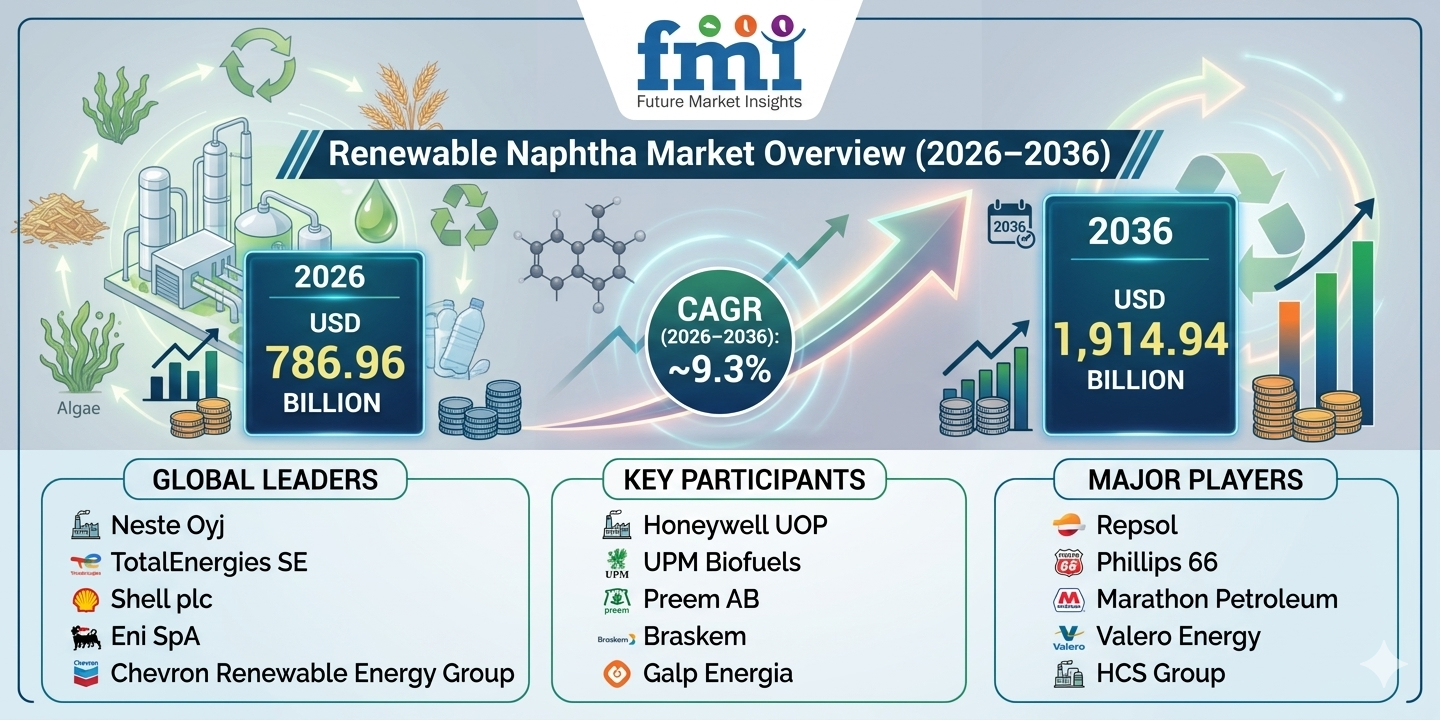
NEWARK, DE, UNITED STATES, March 31, 2026 /EINPresswire.com/ -- The global Renewable Naphtha Market is valued at USD 786.96 billion in 2026 and is projected to reach USD 1,914.94 billion by 2036, expanding at a CAGR of 9.3% from 2026 to 2036. Growth is driven by tightening regulatory frameworks, increasing adoption of mass-balance-certified sustainable materials, and strong demand for low-carbon feedstocks across petrochemical and fuel blending applications.
As the petrochemical industry transitions toward net-zero targets, renewable naphtha is evolving from an alternative fuel blendstock into a strategic raw material—enabling seamless integration into existing steam crackers without requiring major capital investment.
Renewable Naphtha Market Snapshot (2026–2036)
• Market size in 2026: USD 786.96 billion
• Market size in 2036: USD 1,914.94 billion
• CAGR (2026–2036): ~9.3%
• Leading product type: Light renewable naphtha
• Top application segment: Fuel blending
• Dominant certification: ISCC+/ISCC EU
• Fastest-growing country: Netherlands
• Key companies: Neste, TotalEnergies, Shell, Eni, UPM Biofuels
Market Momentum
The Renewable Naphtha Market begins at USD 786.96 billion in 2026, supported by strong regulatory push from frameworks such as the EU Renewable Energy Directive III. Between 2027 and 2030, rapid expansion of co-processing infrastructure and rising adoption of mass-balance certification accelerate market penetration.
Entering 2032 and beyond, feedstock optimization strategies, integrated biorefinery investments, and improved waste oil collection systems further reinforce supply chains. By 2036, the market surpasses USD 1.9 trillion, maintaining steady growth as renewable naphtha becomes a core component of low-carbon petrochemical production.
Request For Sample Report | Customize Report |purchase Full Report - https://www.futuremarketinsights.com/reports/sample/rep-gb-7740
Why the Market is Growing
The Renewable Naphtha Market is expanding as industries seek low-carbon alternatives that do not disrupt existing infrastructure. Renewable naphtha provides a drop-in solution for steam crackers, enabling producers to reduce fossil carbon intensity while maintaining operational efficiency.
Another key growth driver is feedstock flexibility. Renewable naphtha production leverages used cooking oil, waste fats, and bio-based residues, aligning with circular economy objectives. At the same time, mass-balance certification frameworks allow companies to attribute renewable content across product portfolios, amplifying its commercial value.
Additionally, corporate sustainability commitments and consumer demand for eco-friendly packaging are pushing petrochemical companies to adopt certified renewable feedstocks at scale.
Segment Spotlight
1. Application: Fuel Blending Leads Demand
Fuel blending accounts for approximately 58% of total demand, driven by regulatory compliance requirements and the need for low-carbon transportation fuels. Renewable naphtha’s compatibility with gasoline makes it an efficient solution for emission reduction without infrastructure overhaul.
2. Product Type: Light Renewable Naphtha Dominates
Light naphtha represents about 63% of the market share due to its optimal properties for steam cracking and high olefin yields. It remains the preferred feedstock for producing ethylene and propylene in bio-attributed plastics manufacturing.
3. Feedstock: Waste-Based Inputs Gain Traction
Used cooking oil and waste fats contribute nearly 42% of feedstock demand, supported by favorable regulatory incentives and strong carbon reduction credentials.
Drivers, Opportunities, Trends, Challenges
Drivers:
• Petrochemical decarbonization mandates
• Expansion of renewable fuel standards
• Growing demand for sustainable plastics
Opportunities:
• Integrated biorefinery platforms
• Waste-based feedstock aggregation
• Long-term supply contracts with hydrotreaters
Trends:
• Mass-balance certification adoption
• Circular economy integration
• Co-processing in existing refineries
Challenges:
• Feedstock availability constraints
• Price volatility due to SAF competition
• Complex certification and traceability requirements
Country Growth Outlook (2026–2036)
The Netherlands leads global growth at a projected 10.2% CAGR, supported by its role as a major petrochemical and certification hub. Germany and France follow with strong expansion driven by advanced cracker infrastructure and sustainability mandates.
Japan and South Korea demonstrate steady growth through industrial decarbonization strategies, while Brazil benefits from established biofuel ecosystems. The United States maintains significant market share, supported by renewable fuel standards and expanding bioplastics demand.
Competitive Landscape
The Renewable Naphtha Market is moderately consolidated, with leading players controlling a significant share through integrated feedstock sourcing and large-scale hydroprocessing capabilities.
Major companies such as Neste Oyj, TotalEnergies SE, and Shell plc dominate through advanced refining infrastructure, strong certification capabilities, and long-term supply agreements. These players leverage flexibility in allocating feedstocks between renewable diesel, sustainable aviation fuel, and renewable naphtha to maximize margins.
Challengers including Eni SpA, UPM Biofuels, and regional refiners compete by focusing on niche markets, co-processing strategies, and localized supply chains. Competition increasingly centers on feedstock security, certification credibility, and consistent product quality.
Frequently Asked Questions (FAQ)
What is the global Renewable Naphtha Market size?
The market is valued at approximately USD 786.96 billion in 2026 and is projected to reach USD 1,914.94 billion by 2036.
At what rate is the market expected to grow?
The market is forecast to expand at a CAGR of about 9.3% from 2026 to 2036.
What is renewable naphtha?
Renewable naphtha is a bio-based hydrocarbon produced from waste oils and fats, used as a drop-in feedstock for petrochemical production and fuel blending.
Why is renewable naphtha important?
It enables reduction of fossil carbon emissions, supports circular economy goals, and integrates seamlessly into existing refining and petrochemical infrastructure.
Explore More Related Studies Published by FMI Research:
Textile-Integrated Silicone Elastomer Systems for Wearable and Soft Interfaces Market https://www.futuremarketinsights.com/reports/textile-integrated-silicone-elastomer-systems-for-wearable-and-soft-interfaces-market
Polymer Solutions for High Voltage Battery Separator Chemistries Market https://www.futuremarketinsights.com/reports/polymer-solutions-for-high-voltage-battery-separator-chemistries-market
Pilot-to-Commercial Scale Bioplastic Building Block Production Systems Market https://www.futuremarketinsights.com/reports/pilot-to-commercial-scale-bioplastic-building-block-production-systems-market
About Future Market Insights (FMI)
Fture Market Insights, Inc. (FMI) is an ESOMAR-certified, ISO 9001:2015 market research and consulting organization, trusted by Fortune 500 clients and global enterprises. With operations in the U.S., UK, India, and Dubai, FMI provides data-backed insights and strategic intelligence across 30+ industries and 1200 markets worldwide.
Why Choose FMI: https://www.futuremarketinsights.com/why-fmi
Sudip Saha
Future Market Insights Inc.
+ +1 347-918-3531
rahul.singh@futuremarketinsights.com
Legal Disclaimer:
EIN Presswire provides this news content "as is" without warranty of any kind. We do not accept any responsibility or liability for the accuracy, content, images, videos, licenses, completeness, legality, or reliability of the information contained in this article. If you have any complaints or copyright issues related to this article, kindly contact the author above.
