

Germany Anion Exchange Membrane (AEM) Ionomers Market Expands; Siemens Energy Leads
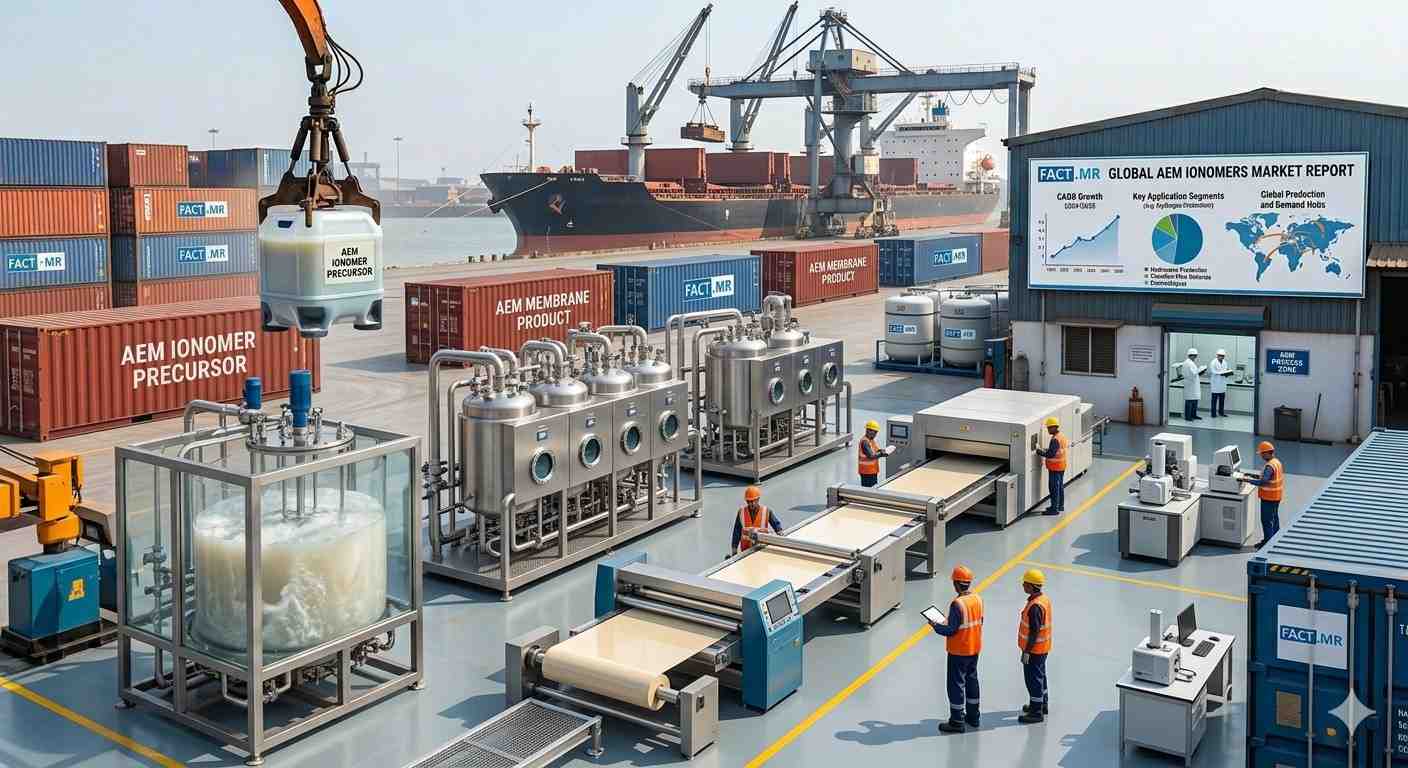
Anion Exchange Membrane (AEM) Ionomers Market
Germany Anion Exchange Membrane (AEM) Ionomers Market grows with hydrogen investments
ROCKVILLE, MD, UNITED STATES, April 14, 2026 /EINPresswire.com/ -- According to Fact.MR’s latest analysis, the Germany Anion Exchange Membrane (AEM) ionomers market is valued at approximately USD 60 million in 2025, projected to reach USD 75 million in 2026, and forecast to expand to USD 240 million by 2036. The market is expected to grow at a CAGR of 12.5%, creating an incremental opportunity of around USD 165 million over the forecast period.The market is undergoing a rapid transformation as Germany positions itself at the forefront of the green hydrogen economy. AEM ionomers are gaining traction as cost-effective alternatives to proton exchange membrane (PEM) systems, enabling scalable and low-carbon hydrogen production. The shift from lab-scale R&D to early commercial deployment is driving demand across electrolyzer and fuel cell applications.
Get detailed market forecasts, competitive benchmarking, and pricing trends:
https://www.factmr.com/connectus/sample?flag=S&rep_id=14710
Quick Stats
Market Size (2025): USD 60 Million
Market Size (2026): USD 75 Million
Forecast Value (2036): USD 240 Million
CAGR (2026–2036): 12.5%
Incremental Opportunity: ~USD 165 Million
Leading Segment: Hydrocarbon ionomers (40% share)
Leading Application: Electrolysis (38% share)
Leading End-use: Energy (hydrogen production)
Key Players: Ionomr Innovations, Versogen, Tokuyama Corporation, AGC Inc., Fujifilm Corporation
Executive Insight for Decision Makers
Germany’s AEM ionomers market is transitioning from technology validation to commercial scale deployment.
Strategic Shift: Movement toward cost-efficient, PFAS-free ionomer chemistries for hydrogen production
What Industry Must Do:
Invest in durability improvements (40,000+ hour stability)
Align early with electrolyzer OEM qualification cycles
Scale local production to meet EU localization mandates
Risk of Inaction:
Loss of position in Europe’s hydrogen supply chain
Inability to compete with low-cost hydrocarbon ionomer suppliers
Delayed entry into long-term OEM contracts
Market Dynamics
Key Growth Drivers
Strong policy push for green hydrogen under EU frameworks
Expansion of electrolyzer deployment across Germany
Increasing demand for low-cost alternatives to PEM systems
Localization mandates boosting EU-based ionomer supply chains
Key Restraints
Limited alkaline stability at high operating temperatures
High cost of membrane production and scaling
Long OEM qualification and testing timelines
Emerging Trends
Shift toward hydrocarbon-based ionomers
Integration with AEM electrolyzers and fuel cells (AEMFC)
Development of PFAS-free sustainable materials
Expansion into water treatment and desalination applications
Segment Analysis
Leading Segment:
Hydrocarbon ionomers (40%), driven by cost advantage and catalyst compatibility
Fastest-Growing Segment:
Electrolysis applications, supported by hydrogen project pipelines
By Application:
Electrolysis dominates (38%)
Fuel cells gaining traction
By End-use:
Energy sector leads
Industrial and water treatment emerging
Strategic Importance:
AEM ionomers are critical for scaling green hydrogen production at lower cost, making them a key enabler of Germany’s energy transition.
Supply Chain Analysis (Critical Insight)
Raw Material Suppliers:
Specialty polymers and fluorochemicals
Catalyst materials and chemical intermediates
Ionomer Manufacturers:
Advanced material companies developing hydrocarbon and perfluorinated ionomers
System Integrators / OEMs:
Electrolyzer and fuel cell manufacturers integrating ionomers into stacks
Distributors & Technology Partners:
Hydrogen infrastructure providers
Engineering and project developers
End-Users:
Energy companies (green hydrogen producers)
Industrial hydrogen users (chemicals, refining)
Mobility sector (fuel cell vehicles)
Who Supplies Whom:
Chemical suppliers → Ionomer producers → Electrolyzer OEMs → Hydrogen developers → Industrial end-users
Germany is emerging as a qualification hub, where supplier-OEM collaboration defines long-term contracts.
Pricing Trends
Commodity vs Premium:
Hydrocarbon ionomers offer cost advantage
Perfluorinated ionomers command premium pricing for durability
Key Influencing Factors:
Material chemistry and performance
Production scale
OEM qualification requirements
Hydrogen policy incentives
Margin Insights:
High margins in early-stage, high-performance materials
Margins expected to decline with scale and commoditization
Regional Analysis (Germany Focus with Benchmarking)
Top Countries by CAGR
China – 13.3%
United States – 12.9%
Germany – 12.5%
Japan – 11.8%
South Korea – 11.2%
Germany Growth Drivers
EU-backed hydrogen investment programs
Strong engineering and electrolyzer manufacturing base
Localization mandates supporting domestic supply chains
Developed vs Emerging Markets
Germany: Focus on technology leadership and quality
Emerging markets: Focus on scale and cost optimization
Competitive Landscape
Market Structure: Emerging and innovation-driven, moderately concentrated
Key Players
Ionomr Innovations Inc.
Versogen Inc.
Tokuyama Corporation
AGC Inc.
Fujifilm Corporation
Asahi Kasei Corporation
Solvay S.A.
Dioxide Materials Inc.
Orion Polymer Corporation
HDF Energy
Competitive Strategies
Focus on material innovation and durability improvement
Early-stage OEM collaboration and qualification
Expansion of production capacity
Regional localization to meet EU compliance
Strategic Takeaways
For Manufacturers
Prioritize durability and conductivity improvements
Align closely with electrolyzer OEMs
For Investors
Strong opportunity in early-stage hydrogen materials ecosystem
Focus on companies with scalable technology platforms
For Distributors
Develop expertise in hydrogen supply chains
Partner with project developers and OEMs
Future Outlook
Germany’s AEM ionomers market is expected to evolve into a core component of the hydrogen economy, characterized by:
Large-scale adoption in electrolyzers
Increased competition between hydrocarbon and fluorinated chemistries
Integration with renewable energy systems
Long-term opportunity lies in cost reduction, durability enhancement, and mass commercialization.
Conclusion
The Germany AEM ionomers market is entering a high-growth phase driven by hydrogen adoption and material innovation. Companies that successfully balance cost, performance, and scalability will secure long-term positioning in Europe’s evolving energy landscape.
Why This Market Matters
AEM ionomers are central to enabling affordable green hydrogen production, positioning Germany as a key player in the global energy transition and decarbonization efforts.
Full Report: Unlock 360° insights for strategic decision making and investment planning-
https://www.factmr.com/checkout/14710
To View Related Report:
Anionic Dispersants Market https://www.factmr.com/report/anionic-dispersants-market
Ion Exchange Resins Market https://www.factmr.com/report/ion-exchange-resins-market
Ion Exchange Softeners Market https://www.factmr.com/report/ion-exchange-softeners-market
High Cation Exchange Capacity Enhancing Fertility Blend Market https://www.factmr.com/report/high-cation-exchange-capacity-enhancing-fertility-blend-market
S. N. Jha
Fact.MR
+1 628-251-1583
email us here
Legal Disclaimer:
EIN Presswire provides this news content "as is" without warranty of any kind. We do not accept any responsibility or liability for the accuracy, content, images, videos, licenses, completeness, legality, or reliability of the information contained in this article. If you have any complaints or copyright issues related to this article, kindly contact the author above.
