

Following the chemical industry news from the world
Provided by AGP
Smart Textiles Market to Reach USD 30.2 Billion by 2034, Growing at 18.80% CAGR | IMARC Group
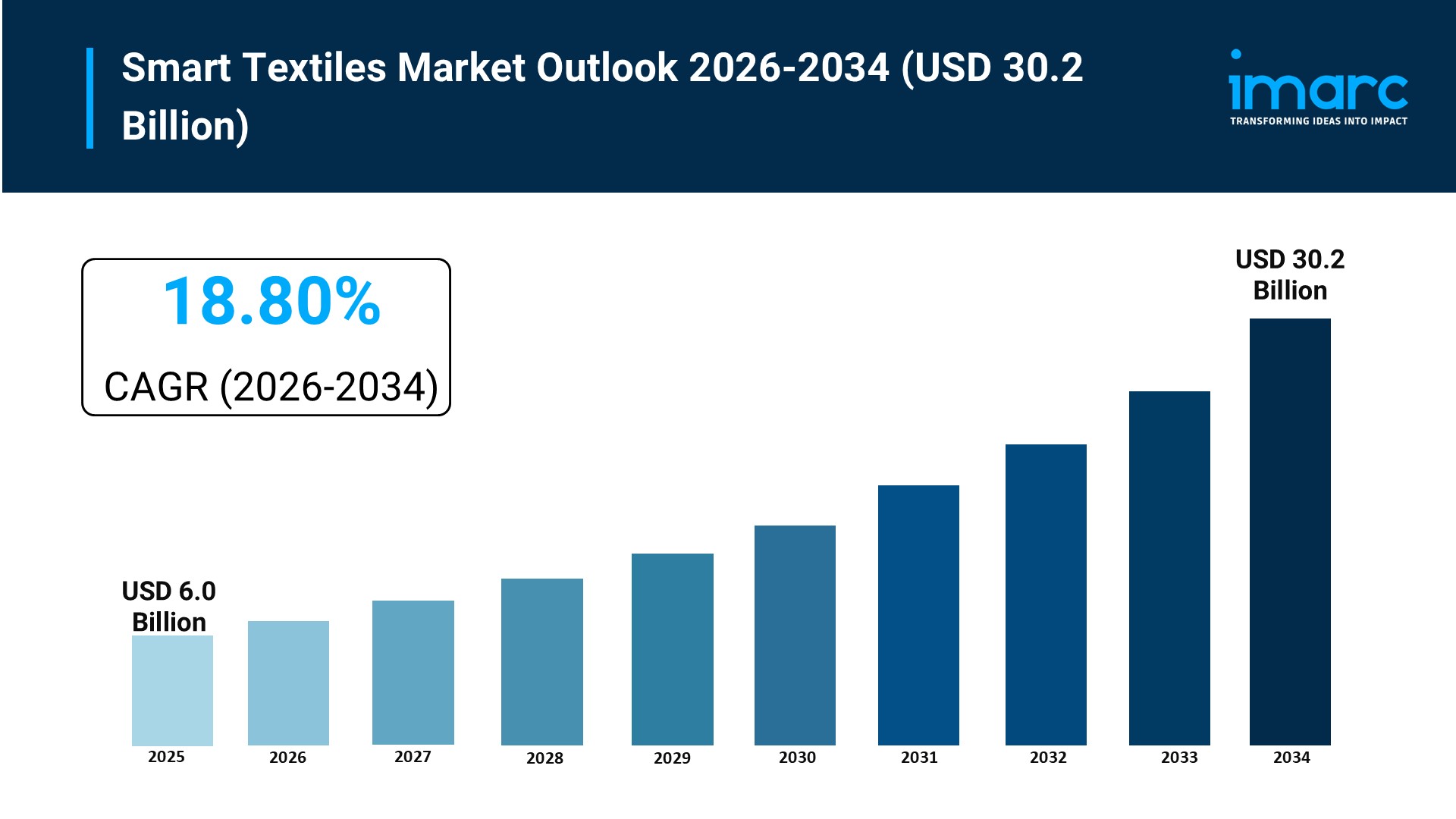
Smart Textiles Market
The global smart textiles market size reached USD 6.0 Billion in 2025.
SHERIDAN, WY, UNITED STATES, May 8, 2026 /EINPresswire.com/ -- The global smart textiles market size reached USD 6.0 Billion in 2025. Looking forward, IMARC Group expects the market to reach USD 30.2 Billion by 2034, exhibiting a growth rate (CAGR) of 18.80% during 2026-2034, according to the latest market research report by IMARC Group. Growth is anchored by the Military and Protection sector holding the largest end-use share, active smart textiles leading by type, energy harvesting dominating by functionality, and North America maintaining clear regional dominance driven by extensive investments in healthcare and defense applications.𝐑𝐞𝐩𝐨𝐫𝐭 𝐇𝐢𝐠𝐡𝐥𝐢𝐠𝐡𝐭𝐬
● 𝐌𝐚𝐫𝐤𝐞𝐭 𝐒𝐢𝐳𝐞 (𝐂𝐮𝐫𝐫𝐞𝐧𝐭): 𝐔𝐒𝐃 𝟔.𝟎 𝐁𝐢𝐥𝐥𝐢𝐨𝐧
● 𝐌𝐚𝐫𝐤𝐞𝐭 𝐅𝐨𝐫𝐞𝐜𝐚𝐬𝐭: 𝐔𝐒𝐃 𝟑𝟎.𝟐 𝐁𝐢𝐥𝐥𝐢𝐨𝐧
● 𝐂𝐀𝐆𝐑 (𝟐𝟎𝟐𝟔–𝟐𝟎𝟑𝟒): 𝟏𝟖.𝟖𝟎%
● 𝐋𝐞𝐚𝐝𝐢𝐧𝐠 𝐑𝐞𝐠𝐢𝐨𝐧: 𝐍𝐨𝐫𝐭𝐡 𝐀𝐦𝐞𝐫𝐢𝐜𝐚
● 𝐓𝐨𝐩 𝐄𝐧𝐝-𝐔𝐬𝐞 𝐒𝐞𝐜𝐭𝐨𝐫: 𝐌𝐢𝐥𝐢𝐭𝐚𝐫𝐲 𝐚𝐧𝐝 𝐏𝐫𝐨𝐭𝐞𝐜𝐭𝐢𝐨𝐧
● 𝐋𝐞𝐚𝐝𝐢𝐧𝐠 𝐓𝐲𝐩𝐞: 𝐀𝐜𝐭𝐢𝐯𝐞 𝐒𝐦𝐚𝐫𝐭 𝐓𝐞𝐱𝐭𝐢𝐥𝐞
● 𝐅𝐚𝐬𝐭𝐞𝐬𝐭-𝐆𝐫𝐨𝐰𝐢𝐧𝐠 𝐅𝐮𝐧𝐜𝐭𝐢𝐨𝐧𝐚𝐥𝐢𝐭𝐲: 𝐄𝐧𝐞𝐫𝐠𝐲 𝐇𝐚𝐫𝐯𝐞𝐬𝐭𝐢𝐧𝐠
● 𝐊𝐞𝐲 𝐆𝐫𝐨𝐰𝐭𝐡 𝐃𝐫𝐢𝐯𝐞𝐫: 𝐈𝐨𝐓 𝐈𝐧𝐭𝐞𝐠𝐫𝐚𝐭𝐢𝐨𝐧 𝐚𝐧𝐝 𝐌𝐚𝐭𝐞𝐫𝐢𝐚𝐥 𝐒𝐜𝐢𝐞𝐧𝐜𝐞 𝐀𝐝𝐯𝐚𝐧𝐜𝐞𝐦𝐞𝐧𝐭𝐬
𝐃𝐨𝐰𝐧𝐥𝐨𝐚𝐝 𝐚 𝐅𝐫𝐞𝐞 𝐒𝐚𝐦𝐩𝐥𝐞 𝐂𝐨𝐩𝐲 𝐨𝐟 𝐭𝐡𝐞 𝐑𝐞𝐩𝐨𝐫𝐭: https://www.imarcgroup.com/smart-textiles-market/requestsample
𝐒𝐦𝐚𝐫𝐭 𝐓𝐞𝐱𝐭𝐢𝐥𝐞𝐬 𝐌𝐚𝐫𝐤𝐞𝐭 𝐎𝐮𝐭𝐥𝐨𝐨𝐤 𝟐𝟎𝟐𝟔–𝟐𝟎𝟑𝟒
Smart textiles refer to materials integrated with advanced technologies to provide the wearer with enhanced functionality. These fabrics embed conductive threads, electronic components, sensors, light-emitting diodes (LEDs), and hands-free computing devices. They sense and react to environmental conditions and stimuli from thermal, mechanical, chemical, and magnetic sources, effectively transforming fabric from passive material into an interactive, data-driven interface.
The Smart Textiles Market is currently valued at USD 6.0 Billion and is projected to reach USD 30.2 Billion, driven by the rising miniaturization of electronics, the integration of artificial intelligence (AI) and the Internet of Things (IoT) with textile platforms, and an expanding pipeline of wearable tech innovations across defense, healthcare, sports, and fashion sectors.
𝐒𝐦𝐚𝐫𝐭 𝐓𝐞𝐱𝐭𝐢𝐥𝐞𝐬 𝐌𝐚𝐫𝐤𝐞𝐭 𝐃𝐫𝐢𝐯𝐞𝐫𝐬 𝟐𝟎𝟐𝟔
𝟏. 𝐑𝐢𝐬𝐢𝐧𝐠 𝐈𝐧𝐭𝐞𝐠𝐫𝐚𝐭𝐢𝐨𝐧 𝐰𝐢𝐭𝐡 𝐈𝐨𝐓 𝐃𝐞𝐯𝐢𝐜𝐞𝐬
The growing usage of smart textiles as an interface for IoT applications is one of the primary factors stimulating the market. Fabrics embedded with sensors can communicate physiological parameters including location, heart rate, perspiration levels, blood pressure, and body temperature, enabling seamless data transfer to connected devices without external hardware. The proliferation of IoT ecosystems across consumer, industrial, and healthcare settings is making smart textiles an increasingly central component in wearable technology infrastructure.
𝟐. 𝐂𝐨𝐧𝐭𝐢𝐧𝐮𝐨𝐮𝐬 𝐀𝐝𝐯𝐚𝐧𝐜𝐞𝐦𝐞𝐧𝐭𝐬 𝐢𝐧 𝐌𝐚𝐭𝐞𝐫𝐢𝐚𝐥 𝐒𝐜𝐢𝐞𝐧𝐜𝐞
Researchers globally are conducting R&D activities incorporating conductive polymers, nanomaterials, and advanced composite structures into traditional fabrics. In April 2024, a team in the UK achieved a significant advancement by producing a smart fabric capable of transforming both color and shape in response to heat and electricity. Similarly, engineers at Stanford University developed a low-cost plastic clothing material that cools the body more efficiently than conventional synthetic or natural fabrics. These material-level breakthroughs are expanding the functional envelope of smart textiles across specialized applications ranging from consumer electronics to military use.
𝟑. 𝐆𝐨𝐯𝐞𝐫𝐧𝐦𝐞𝐧𝐭 𝐒𝐮𝐩𝐩𝐨𝐫𝐭 𝐚𝐧𝐝 𝐈𝐧𝐬𝐭𝐢𝐭𝐮𝐭𝐢𝐨𝐧𝐚𝐥 𝐁𝐚𝐜𝐤𝐢𝐧𝐠
Increasing support from government bodies is helping small startups scale and encouraging collaborations between technology companies and textile manufacturers. In India, the Indian Institute of Technology (IIT) signed a memorandum of understanding with Troop Comforts Limited (TCL) to introduce smart protective clothing for security forces. In North America, government grants and subsidies continue to fund adaptive thermal clothing, IoT-integrated defense garments, and healthcare monitoring textiles. India's Production Linked Incentive (PLI) scheme for technical textiles further encourages domestic manufacturing and innovation across the Asia Pacific region.
𝟒. 𝐆𝐫𝐨𝐰𝐢𝐧𝐠 𝐅𝐢𝐭𝐧𝐞𝐬𝐬 𝐚𝐧𝐝 𝐖𝐞𝐥𝐥𝐧𝐞𝐬𝐬 𝐂𝐨𝐧𝐬𝐜𝐢𝐨𝐮𝐬𝐧𝐞𝐬𝐬
The rising health and wellness movement is propelling smart textile adoption in the sports and fitness industry. Companies such as Wearable X have introduced smart yoga pants that provide haptic feedback, enabling small vibrations on body parts requiring adjustment, synced via an app offering personalized pose guidance. Nextiles entered the sports performance industry by integrating conventional stitching methods with printed circuit boards that record biomechanical and physiological data on a single platform. These developments are eliminating the need for standalone devices such as chest straps and wrist-worn trackers.
𝐒𝐩𝐞𝐚𝐤 𝐃𝐢𝐫𝐞𝐜𝐭𝐥𝐲 𝐰𝐢𝐭𝐡 𝐚𝐧 𝐀𝐧𝐚𝐥𝐲𝐬𝐭 𝐟𝐨𝐫 𝐂𝐮𝐬𝐭𝐨𝐦𝐢𝐳𝐞𝐝 𝐈𝐧𝐬𝐢𝐠𝐡𝐭𝐬: https://www.imarcgroup.com/request?type=report&id=1986&flag=C
𝐒𝐦𝐚𝐫𝐭 𝐓𝐞𝐱𝐭𝐢𝐥𝐞𝐬 𝐌𝐚𝐫𝐤𝐞𝐭 𝐓𝐫𝐞𝐧𝐝𝐬 𝟐𝟎𝟐𝟔
𝐄𝐜𝐨-𝐅𝐫𝐢𝐞𝐧𝐝𝐥𝐲 𝐚𝐧𝐝 𝐒𝐮𝐬𝐭𝐚𝐢𝐧𝐚𝐛𝐥𝐞 𝐏𝐫𝐨𝐝𝐮𝐜𝐭𝐢𝐨𝐧
A key emerging trend is the inflating focus by key players on adopting eco-friendly processes and materials in smart textiles production. In May 2024, Schoeller Textil AG announced the launch of its sustainable collection Re-Source, developed using recycled materials from both bio-based and spandex fabrics, delivering modern design alongside high functionality. In June 2025, textile recycler Syre announced partnerships with U.S. retailers Gap and Target to supply recycled polyester, with Gap procuring 10,000 tons per year, while Syre ramped up production through a new facility in North Carolina.
𝐒𝐞𝐥𝐟-𝐀𝐝𝐚𝐩𝐭𝐢𝐯𝐞 𝐚𝐧𝐝 𝐔𝐥𝐭𝐫𝐚-𝐒𝐦𝐚𝐫𝐭 𝐓𝐞𝐱𝐭𝐢𝐥𝐞 𝐃𝐞𝐯𝐞𝐥𝐨𝐩𝐦𝐞𝐧𝐭
The market is undergoing rapid transformation and scale-up as next-generation ultra-smart fabrics advance beyond sensing capabilities into self-adaptation and real-time response. These textiles can harvest energy from movement, actively regulate body temperature, and exhibit self-healing properties for minor structural damage. The convergence of IoT and textile engineering is transforming garments into intelligent data services capable of cloud connectivity and real-time biometric analytics.
𝐅𝐚𝐬𝐡𝐢𝐨𝐧 𝐈𝐧𝐝𝐮𝐬𝐭𝐫𝐲 𝐀𝐝𝐨𝐩𝐭𝐢𝐨𝐧
Prominent fashion brands including Lululemon, Uniqlo, Levi's, and Tommy Hilfiger are incorporating smart fabrics into commercial collections. CuteCircuit utilizes illuminated smart fabrics for haute couture, while Spinali Design in France produces beachwear with integrated UV sensors informing wearers when to apply sunscreen. Google's Project Jacquard, developed in collaboration with Levi Strauss, introduced a smart denim jacket capable of gesture-based smartphone control. In April 2024, Crystal International Group launched its "Smart-Fit" denim jeans in partnership with LYCRA and Advance Denim, blending comfort features with body-enhancing technologies across a nine-piece collection.
𝐒𝐞𝐧𝐬𝐨𝐫 𝐓𝐞𝐜𝐡𝐧𝐨𝐥𝐨𝐠𝐲 𝐃𝐞𝐯𝐞𝐥𝐨𝐩𝐦𝐞𝐧𝐭𝐬
Developments in sensor technology are driving new functionality categories within smart textiles. In April 2025, DuPont unveiled its Activegrid silver nanowire-based transparent conductive ink and film solutions at Electronics Manufacturing Korea and Automotive World Korea, introducing transparent conductive technologies for LiDAR heating, EMI shielding, smart surfaces, and OLED displays. In March 2024, the Central Institute of Research on Cotton Technology (ICAR) in Mumbai organized a three-day training on Smart Textiles and its Evaluation, specifically designed to upgrade skills and expertise among scheduled caste community candidates under the Indian Council of Agricultural Research's Scheduled Caste Sub Plan scheme.
𝐒𝐦𝐚𝐫𝐭 𝐓𝐞𝐱𝐭𝐢𝐥𝐞𝐬 𝐌𝐚𝐫𝐤𝐞𝐭 𝐒𝐞𝐠𝐦𝐞𝐧𝐭𝐚𝐭𝐢𝐨𝐧
𝐁𝐲 𝐓𝐲𝐩𝐞
● Passive Smart Textile
● Active Smart Textile
● Leading Segment: Active Smart Textile
Active smart textiles account for the largest market share, propelled by rising applications across automotive, healthcare, aerospace, and military industries. These textiles adapt and change their functionality in response to external environments, offering enhanced comfort, performance, and monitoring capabilities. Loomia Technologies Inc. introduced the Loomia Electronic Layer (LEL), directly integrable into garments, providing a subtle yet comfortable climate management system. Government grants and increased funding for IoT and material science research continue to accelerate this segment.
𝐁𝐲 𝐅𝐮𝐧𝐜𝐭𝐢𝐨𝐧𝐚𝐥𝐢𝐭𝐲
● Sensing
● Energy Harvesting
● Luminescence and Aesthetics
● Thermoelectricity
● Others
Leading Segment: Energy Harvesting
Energy harvesting functionality is gaining considerable traction due to the inflating focus on sustainability and efficient resource usage. These textiles capture and store energy from thermal, solar, and mechanical sources. In April 2024, a team at Cambridge University developed a fabric incorporating LEDs, energy harvesting, storage capabilities, and sensors into a single garment. Industries including healthcare are adopting energy-harvesting textiles to power medical sensors without requiring frequent battery replacements.
𝐁𝐲 𝐄𝐧𝐝-𝐔𝐬𝐞 𝐒𝐞𝐜𝐭𝐨𝐫
● Military and Protection
● Healthcare
● Sports and Fitness
● Fashion and Entertainment
● Transportation
● Architecture
● Others
Leading Segment: Military and Protection
The military and protection sector holds the largest end-use share, driven by the increasing need for improved safety, performance, and communication among defense personnel. Smart textiles offer body temperature regulation, advanced camouflage, and integrated communication systems. UMass Lowell develops carbon-based transistors, high-frequency printed conformal antennas, and wearable antennas for military applications. In May 2024, researchers in the U.S. introduced wearable gas sensors integrated with uniforms to monitor the health and safety of soldiers in hazardous environments.
𝐑𝐞𝐠𝐢𝐨𝐧𝐚𝐥 𝐈𝐧𝐬𝐢𝐠𝐡𝐭𝐬: 𝐒𝐦𝐚𝐫𝐭 𝐓𝐞𝐱𝐭𝐢𝐥𝐞𝐬 𝐌𝐚𝐫𝐤𝐞𝐭
𝐍𝐨𝐫𝐭𝐡 𝐀𝐦𝐞𝐫𝐢𝐜𝐚 -- 𝐌𝐚𝐫𝐤𝐞𝐭 𝐋𝐞𝐚𝐝𝐞𝐫
North America exhibits clear dominance in the global Smart Textiles Market, attributable to extensive investments in R&D, particularly in healthcare and defense sectors. The military in Canada deployed full-fabric keyboards in IAV Stryker units, designed for enhanced transport comfort. Acellent Technologies Inc., in collaboration with the U.S. Army, developed a smart armor system for monitoring body armor structures. Kestrel Materials commercializes thermally adaptive garment technology based on textile bimorph structure. Strong government frameworks, inflating IoT device penetration, and robust institutional support are all reinforcing regional leadership.
𝐀𝐬𝐢𝐚 𝐏𝐚𝐜𝐢𝐟𝐢𝐜 -- 𝐅𝐚𝐬𝐭𝐞𝐬𝐭-𝐆𝐫𝐨𝐰𝐢𝐧𝐠 𝐑𝐞𝐠𝐢𝐨𝐧
Asia Pacific is emerging as the fastest-growing region, supported by government policies promoting high-performance materials including India's PLI scheme for technical textiles. China's strong manufacturing capabilities, government support, and rising consumer demand for health and fitness technologies create a progressive environment for market expansion. The defense sectors in both India and China are adopting smart uniforms with real-time monitoring, environmental sensing, and adaptive camouflage. In January 2025, TEIJIN LIMITED and Asahi Kasei Corporation signed a business integration agreement for their advanced materials subsidiaries to consolidate R&D and manufacturing capabilities.
𝐄𝐮𝐫𝐨𝐩𝐞
Europe maintains a prominent role in the market, with countries including Germany, France, and the Netherlands investing heavily in smart textile R&D through EU-funded programs such as Horizon Europe. The European Commission's Green Deal and Digital Product Passport initiative are driving demand for traceable, recyclable smart fabrics. Europe's established textile industry, combined with an emphasis on circular economy principles, creates favorable conditions for sustainable smart textile development.
𝐌𝐢𝐝𝐝𝐥𝐞 𝐄𝐚𝐬𝐭 𝐚𝐧𝐝 𝐀𝐟𝐫𝐢𝐜𝐚
The United Arab Emirates leads the region through Dubai's Smart City initiative, which promotes wearable technology integration in public safety and healthcare. Saudi Arabia's Vision 2030 includes funding for health tech innovation, with King Abdullah University of Science and Technology (KAUST) developing solar-powered smart fabrics for desert operations. The Dubai Police Force introduced smart uniforms embedded with GPS and stress-level sensors to enhance officer safety during operations.
𝐊𝐞𝐲 𝐂𝐨𝐦𝐩𝐚𝐧𝐢𝐞𝐬 𝐢𝐧 𝐭𝐡𝐞 𝐒𝐦𝐚𝐫𝐭 𝐓𝐞𝐱𝐭𝐢𝐥𝐞𝐬 𝐌𝐚𝐫𝐤𝐞𝐭
Major players profiled in the IMARC Group report include:
● AiQ Smart Clothing Inc.
● Hexoskin (Carre Technologies Inc.)
● Interactive Wear AG
● Outlast Technologies GmbH
● Schoeller Textil AG
● Sensoria Health Inc.
● Wearable X
● Xenoma Inc.
𝐎𝐭𝐡𝐞𝐫 𝐓𝐫𝐞𝐧𝐝𝐢𝐧𝐠 𝐑𝐞𝐩𝐨𝐫𝐭𝐬 𝐁𝐲 𝐈𝐌𝐀𝐑𝐂 𝐆𝐫𝐨𝐮𝐩:
Industrial Robotics Market Research Report
Mobile Gaming Market Research Report
Video Conferencing Market Research Report
6g Market: https://www.imarcgroup.com/6g-market-report
Payment Gateways Market: https://www.imarcgroup.com/payment-gateways-market
𝐊𝐞𝐲 𝐓𝐚𝐤𝐞𝐚𝐰𝐚𝐲𝐬 𝐟𝐫𝐨𝐦 𝐭𝐡𝐞 𝐑𝐞𝐩𝐨𝐫𝐭
● Market projected to grow from USD 6.0 Billion (2025) to USD 30.2 Billion by 2034 at a 18.80% CAGR.
● Military and Protection sector accounts for the largest end-use share
● Active Smart Textile leads by type due to adaptive, real-time response capabilities
● Energy Harvesting holds the largest functionality share, driven by sustainability and IoT power demands
● North America dominates regionally with the highest R&D investment concentration in healthcare and defense
● Asia Pacific is the fastest-growing region, anchored by India's PLI scheme and China's manufacturing scale
● Key trends include eco-friendly production, ultra-smart self-adaptive fabrics, and AI-integrated sensor systems
𝐀𝐛𝐨𝐮𝐭 𝐈𝐌𝐀𝐑𝐂 𝐆𝐫𝐨𝐮𝐩
IMARC Group is a leading market research company that offers management strategy and market research worldwide. The company partners with clients across all sectors and regions to identify their highest-value opportunities, address their most critical challenges, and transform their businesses. IMARC's information products cover major market, scientific, economic, and technological developments for business leaders in pharmaceutical, industrial, and high-technology organizations.
𝐂𝐨𝐧𝐭𝐚𝐜𝐭 𝐔𝐬
IMARC Group
134 N 4th St., Brooklyn, NY 11249, USA
Email: sales@imarcgroup.com
Tel: +1-631-791-1145
Website: www.imarcgroup.com
Elena Anderson
IMARC Services Private Limited
+1 201-971-6302
email us here
Legal Disclaimer:
EIN Presswire provides this news content "as is" without warranty of any kind. We do not accept any responsibility or liability for the accuracy, content, images, videos, licenses, completeness, legality, or reliability of the information contained in this article. If you have any complaints or copyright issues related to this article, kindly contact the author above.
