

Following the chemical industry news from the world
Provided by AGP
[Latest] Granular Urea Market Size Will Attain USD 67.11 Billion by 2034 Registering a Promising CAGR of 4.56% - Exclusive Report by ZMR | Global Granular Urea Market Size, Share, Trends Analysis Report
NEW YORK, USA, May 19, 2026 (GLOBE NEWSWIRE) -- Zion Market Research has published a new research report titled “Granular Urea Market By Product Type (Prilled Urea, Granular Urea, Coated and Controlled-Release Urea), By Application (Agricultural Fertilizers, Industrial Uses, Animal Feed Supplements, and Resin and Adhesive Production), By End-User (Crop Farmers, Fertilizer Blenders and Distributors, Chemical Manufacturers, and Livestock Feed Producers), By Distribution Channel (Direct Farm Sales, Agricultural Cooperatives, Fertilizer Retailers and Dealers, and Online Agricultural Platforms), and By Region - Global and Regional Industry Overview, Market Intelligence, Comprehensive Analysis, Historical Data, and Forecasts 2025 - 2034” in its research database.
“According to the latest research study, the global granular urea market size was valued at around USD 44.99 billion in 2024. The market is expected to grow at a CAGR of 4.56% and is anticipated to reach a value of USD 67.11 billion by 2034.”
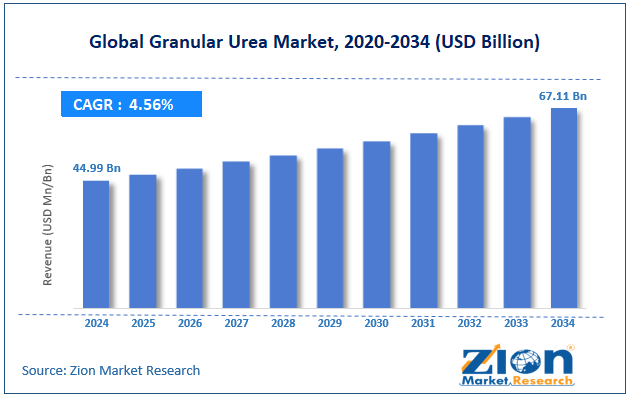
Get a Free Sample PDF of this Research Report for more Insights - https://www.zionmarketresearch.com/sample/granular-urea-market
Granular Urea Market Overview:
Granular urea is a high-nitrogen fertilizer widely used to enhance crop growth and farm productivity. It is produced by combining ammonia and carbon dioxide under controlled conditions to form urea, which is then shaped into small, round, durable granules. These granules offer ease of handling, storage, and application, with approximately 46% nitrogen content that provides efficient nutrient delivery compared to many other fertilizers.
Rising global food demand, driven by population growth and the need for higher crop yields on limited arable land, strongly supports expansion. Volatility in natural gas prices, the primary raw material, creates cost uncertainties and pricing pressures. Advancements in precision agriculture, controlled-release technologies, and sustainable production methods present significant opportunities. Environmental concerns over nitrogen losses, regulatory restrictions, and trade policy uncertainties pose notable challenges to consistent market growth.
Report Scope:
| Report Attribute | Report Details |
| Market Size in 2024 | USD 44.99 Billion |
| Market Forecast in 2034 | USD 67.11 Billion |
| Growth Rate | CAGR of 4.56% |
| Base Year | 2024 |
| Forecast Years | 2025- 2034 |
| Key Companies Covered | Yara International, CF Industries Holdings, Nutrien Limited, EuroChem Group, OCP Group, Acron Group, Koch Fertilizer, Rashtriya Chemicals and Fertilizers Limited, Grupa Azoty, SABIC Agri-Nutrients, and others. |
| Segments Covered | By Product Type, By Application, By End-User, By Distribution Channel, and By Region |
| Regions Covered | North America, Europe, Asia Pacific, Latin America, and the Middle East & Africa |
| Customization Scope | Avail customized purchase options to meet your exact research needs. |
Directly Purchase a Copy of the Report | Quick Delivery Available - https://www.zionmarketresearch.com/buynow/su/granular-urea-market
Key Insights
- As per the analysis, the granular urea market share is likely to grow at a CAGR of around 4.56% between 2025 and 2034.
- The granular urea market size was worth around $44.99 billion in 2024 and is estimated to hit approximately $67.11 billion by 2034. Due to a variety of driving factors, the market is predicted to rise at a significant rate.
- The granular urea market is driven by rising global food demand, expanding cultivated land, increased adoption of mechanized farming, and growing awareness of nitrogen management in crop production.
- Based on the product type, the granular urea segment dominates the global market owing to its superior physical properties, better handling with modern machinery, and preference among large-scale farmers.
- Based on the application, the agricultural fertilizers segment dominates due to its critical role in boosting crop yields for major staples like rice, wheat, and corn.
- Based on the end-user, the crop farmers segment dominates as they represent the primary direct users of granular urea for essential crop nutrition.
- Based on the distribution channel, the fertilizer retailers and dealers segment dominates, supported by their extensive reach, agronomic advice, and credit services to farmers.
- Based on the region, Asia Pacific continues to dominate the global market, supported by vast agricultural land, large farming populations, strong government support, and major producing countries like China and India.
Granular Urea Market: Dynamics
Key Growth Drivers
How do rising global food demand and agricultural modernization accelerate growth in the Granular Urea market?
The granular urea market grows steadily as the global population increases and the demand for higher food production intensifies. Farmers face pressure to maximize yields from limited arable land, making high-nitrogen fertilizers like granular urea essential for maintaining soil fertility and boosting productivity in key crops such as rice, wheat, and corn.
Mechanization in developing regions further drives demand, as granular urea’s larger, stronger particles spread more evenly with modern equipment, reduce waste, and improve application efficiency compared to prilled forms.
How does industrial demand strengthen the Granular Urea market?
Beyond agriculture, industrial applications contribute significantly to market expansion. Granular urea is used in diesel exhaust fluids for emission control, resins for wood products in construction and furniture, and various chemical manufacturing processes. Stricter environmental regulations on vehicle emissions and rising urbanization support sustained industrial consumption, diversifying the demand base and enhancing market resilience.
Restraints
Why do natural gas price volatility and environmental regulations restrain the Granular Urea market?
Natural gas, the primary feedstock for urea production, experiences price fluctuations that directly impact manufacturing costs and final fertilizer prices. Higher costs can reduce affordability for farmers, particularly in price-sensitive markets, leading to lower application rates and subdued demand.
Growing environmental regulations targeting nitrogen pollution from runoff and emissions add compliance burdens, potentially limiting usage in regions with strict rules and increasing costs for enhanced-efficiency formulations.
Opportunities
How do precision agriculture and sustainable innovations create prospects in the Granular Urea market?
The rise of precision farming tools, including soil sensors and variable-rate application, increases demand for high-quality granular and controlled-release urea that minimizes waste and maximizes nutrient uptake. Government subsidies and food security programs in developing regions further expand access and usage.
Investment in green ammonia, low-carbon production, and inhibitor-enhanced products opens avenues for premium, environmentally friendly offerings that appeal to sustainability-focused buyers and regulators.
Browse the full “Granular Urea Market By Product Type (Prilled Urea, Granular Urea, Coated and Controlled-Release Urea), By Application (Agricultural Fertilizers, Industrial Uses, Animal Feed Supplements, and Resin and Adhesive Production), By End-User (Crop Farmers, Fertilizer Blenders and Distributors, Chemical Manufacturers, and Livestock Feed Producers), By Distribution Channel (Direct Farm Sales, Agricultural Cooperatives, Fertilizer Retailers and Dealers, and Online Agricultural Platforms), and By Region - Global and Regional Industry Overview, Market Intelligence, Comprehensive Analysis, Historical Data, and Forecasts 2025 - 2034” Report at https://www.zionmarketresearch.com/report/granular-urea-market
Granular Urea Market: Segmentation
The granular urea market is segmented by product type, application, end-user, distribution channel, and region.
Based on Product Type, the granular urea market is divided into prilled urea, granular urea, and coated and controlled-release urea. The granular urea segment is the most dominant, followed by coated and controlled-release urea. Granular urea dominates due to its superior handling characteristics, compatibility with mechanized spreading equipment, reduced moisture absorption, and strong preference among commercial farmers, which drives consistent demand and supports overall market growth through efficient field application.
Based on Application, the granular urea market is divided into agricultural fertilizers, industrial uses, animal feed supplements, and resin and adhesive production. The agricultural fertilizers segment is the most dominant, followed by resin and adhesive production. Agricultural fertilizers dominate because of the essential role of nitrogen in crop nutrition and the massive scale of global food production needs, directly driving high-volume consumption and market expansion.
Based on End-User, the granular urea market is divided into crop farmers, fertilizer blenders and distributors, chemical manufacturers, and livestock feed producers. The crop farmers segment is the most dominant, followed by fertilizer blenders and distributors. Crop farmers dominate as they represent the core end-users applying granular urea directly for staple crop nutrition, accounting for the majority of volume and sustaining steady market demand.
Based on Distribution Channel, the granular urea market is divided into direct farm sales, agricultural cooperatives, fertilizer retailers and dealers, and online agricultural platforms. The fertilizer retailers and dealers segment is the most dominant, followed by agricultural cooperatives. Fertilizer retailers and dealers dominate due to their wide reach, provision of agronomic support, and credit facilities, which facilitate bulk access for small and medium farmers and drive efficient market distribution.
Regional Scope:
Why will Asia Pacific continue to dominate the global Granular Urea market during the projection period?
Asia Pacific maintains its leading position through vast agricultural areas, a huge farming population, and heavy reliance on nitrogen fertilizers to meet rising food security needs. China stands as the world’s largest producer and consumer, supported by large-scale grain and vegetable farming and active government management of supply and exports. India follows closely with millions of smallholder farmers growing rice, wheat, and sugarcane, bolstered by subsidy programs that sustain strong domestic demand. Southeast Asian countries like Vietnam, Indonesia, Thailand, and the Philippines contribute additional growth through expanding rice cultivation and commercial agriculture. Strong local production capacities, supportive policies, and continuous efforts to boost yields in the face of population growth reinforce the region’s long-term dominance.
North America holds the second position with advanced mechanized farming in the United States and Canada focused on corn, wheat, and soybeans. Europe emphasizes efficiency and environmental compliance, while Latin America and the Middle East & Africa show promising growth through expanding agricultural development and local production initiatives.
Recent Developments
- In March 2026, CF Industries announced the conversion of over 100 railcars to enhance its granular urea distribution network across the United States, aiming to improve supply efficiency during peak fertilizer demand seasons.
Request For Customization on This Report as Per Your Requirements - https://www.zionmarketresearch.com/custom/10565
Granular Urea Market: Competitive Landscape
The report contains qualitative and quantitative research on the global granular urea market, as well as detailed insights and development strategies employed by the leading competitors.
Some of the leading players in the global granular urea market include;
- Yara International
- CF Industries Holdings
- Nutrien Limited
- EuroChem Group
- OCP Group
- Acron Group
- Koch Fertilizer
- Rashtriya Chemicals and Fertilizers Limited
- Grupa Azoty
- SABIC Agri-Nutrients
What are the key trends in the Granular Urea Market?
Adoption of controlled-release and enhanced-efficiency formulations
Manufacturers are increasingly focusing on coated and inhibitor-enhanced granular urea to improve nitrogen use efficiency, reduce environmental losses, and align with sustainability regulations and precision farming practices.
Shift toward sustainable and low-carbon production methods
There is growing investment in green ammonia technologies using renewable energy and development of traceable, low-carbon urea products to meet environmental standards and appeal to eco-conscious markets.
The global granular urea market is segmented as follows:
By Product Type
- Prilled Urea
- Granular Urea
- Coated and Controlled-Release Urea
By Application
- Agricultural Fertilizers
- Industrial Uses
- Animal Feed Supplements
- Resin and Adhesive Production
By End-User
- Crop Farmers
- Fertilizer Blenders and Distributors
- Chemical Manufacturers
- Livestock Feed Producers
By Distribution Channel
- Direct Farm Sales
- Agricultural Cooperatives
- Fertilizer Retailers and Dealers
- Online Agricultural Platforms
By Region
- North America
- The U.S.
- Canada
- Europe
- France
- The UK
- Spain
- Germany
- Italy
- Rest of Europe
- Asia Pacific
- China
- Japan
- India
- Southeast Asia
- Rest of Southeast Asia
- The Middle East & Africa
- GCC
- South Africa
- Rest of the Middle East & Africa
- Latin America
- Brazil
- Argentina
- Rest of Latin America
Request Free Brochure of the Global Granular Urea Market @ https://www.zionmarketresearch.com/requestbrochure/granular-urea-market
Key Questions Answered in This Report:
- What is granular urea?
- What key factors will influence the granular urea market growth from 2025 to 2034?
- What will be the value of the granular urea market during 2025–2034?
- What will be the compound annual growth rate value of the granular urea market during 2025–2034?
- Which region will contribute the most to the granular urea market?
- Which are the major players driving the growth of the granular urea market?
- What can be expected from the global granular urea market report?
- Which distribution channel/ sales channel segment holds the largest market share in the granular urea market?
- What regulatory or environmental factors are affecting the growth of the granular urea market?
- How will macroeconomic factors impact the granular urea market in the coming years?
Key Offerings:
- Full in-depth analysis of the parent market
- Important changes in market dynamics
- Segmentation details of the market
- Previous, ongoing, and projected market analysis in terms of volume and value
- Assessment of niche industry developments
- Market share analysis
- Key strategies of major players
- Emerging segments and regional markets
- Testimonials to companies in order to fortify their foothold in the market
Browse Other Related Research Reports
- Household Water Softener System Market By Product Type (Salt Based Water Softeners, Salt Free Water Softeners, Dual Tank Water Softeners, Single Tank Water Softeners), By Technology (Ion Exchange, Reverse Osmosis, Electromagnetic), By Distribution Channel (Online Retailers, Offline Retailers, Direct Sales), and By Region - Global and Regional Industry Overview, Market Intelligence, Comprehensive Analysis, Historical Data, and Forecasts 2025 - 2034
- Industrial and Institutional Cleaning Chemicals Market By Raw Material (Chlor-alkali, Phosphates, Solvents, Surfactant, Biocides, and Others), By Product (General Purpose Cleaners, Vehicle Wash Products, Disinfectants and Sanitizers, Laundry Care Products, and Others), By End Use (Commercial and Manufacturing), and By Region - Global and Regional Industry Overview, Market Intelligence, Comprehensive Analysis, Historical Data, and Forecasts 2025 - 2034
- High Quality Silicone Release Liners Market By Type (Single Side Coated, Double Side Coated), By Substrate Material (Paper-based Release Liners, Film-based Release Liners), By Application (Labels and Packaging, Medical & Healthcare, Industrial and Manufacturing), and By Region - Global and Regional Industry Overview, Market Intelligence, Comprehensive Analysis, Historical Data, and Forecasts 2025 - 2034
- Hydraulic Hose And Fittings Market By Type (Low Pressure, Medium Pressure, and High Pressure), By Distribution Channel (Offline and Online), By End-User (Construction Machinery, Material Handling Machinery, Agricultural Machinery, and Others), and By Region - Global and Regional Industry Overview, Market Intelligence, Comprehensive Analysis, Historical Data, and Forecasts 2025 - 2034
- Silkscreen Glass Market By Type (Energy-Saving, Clear/Tinted, and Others), By Application (Automotive, Architecture & Interior Design, Consumer Electronics, and Others), and By Region - Global and Regional Industry Overview, Market Intelligence, Comprehensive Analysis, Historical Data, and Forecasts 2025 - 2034
- Magnesium Recycling Market By Type (Magnesium Oxide Residues and Scrap Magnesium Alloys), By Recycling Method (Hydrometallurgical Recycling and Pyrometallurgical Recycling), By Magnesium Alloy Type (Zinc-based Alloys, Aluminum-based Alloys, Rare Earth Element-based Alloys, and Others), By End-User Industry (Construction, Aerospace, Automotive, Electronics, and Others), and By Region - Global and Regional Industry Overview, Market Intelligence, Comprehensive Analysis, Historical Data, and Forecasts 2025 - 2034
- Inorganic Corrosion Inhibitors Market By Type (Anodic Inhibitor and Cathodic Inhibitor), By Treatment (Sprays, Coatings, and Others), By Application (Oil & Gas, Chemicals & Petrochemicals, Water Treatment, Construction, Metalworking, and Others), and By Region - Global and Regional Industry Overview, Market Intelligence, Comprehensive Analysis, Historical Data, and Forecasts 2025 - 2034
- High Purity Alumina Market By Product (4N, 5N, 6N), By Application (LED, Semiconductor, Phosphor, Sapphire, Lithium-ion Batteries, and Others), By End-Use Industry (Consumer Electronics, Automotive, Aerospace and Defense, Healthcare and Medical Devices, Telecommunications, Energy and Power, Industrial Manufacturing, and Others), and By Region - Global and Regional Industry Overview, Market Intelligence, Comprehensive Analysis, Historical Data, and Forecasts 2025 - 2034
About Zion Market Research:
Zion Market Research is a leading market research organization offering industry expertise and scrupulous consulting services to clients for their business development. The reports and services offered by Zion Market Research are used by prestigious academic institutions, start-ups, and companies globally to measure and understand the changing international and regional business backgrounds.
Contact Us:
Zion Market Research
USA/Canada Toll Free: 1 (855) 465-4651 | Newark: 1 (302) 444-0166
India: +91 7768 006 007 | +91 7768 006 008
Email: sales@zionmarketresearch.com | Web: https://www.zionmarketresearch.com/
Follow Us on - LinkedIn | X | Facebook | Pinterest | YouTube


Legal Disclaimer:
EIN Presswire provides this news content "as is" without warranty of any kind. We do not accept any responsibility or liability for the accuracy, content, images, videos, licenses, completeness, legality, or reliability of the information contained in this article. If you have any complaints or copyright issues related to this article, kindly contact the author above.
