

HAIVYA Bioacoustic Platform Reports 120.9% Yield Increase in Third-Party Trial
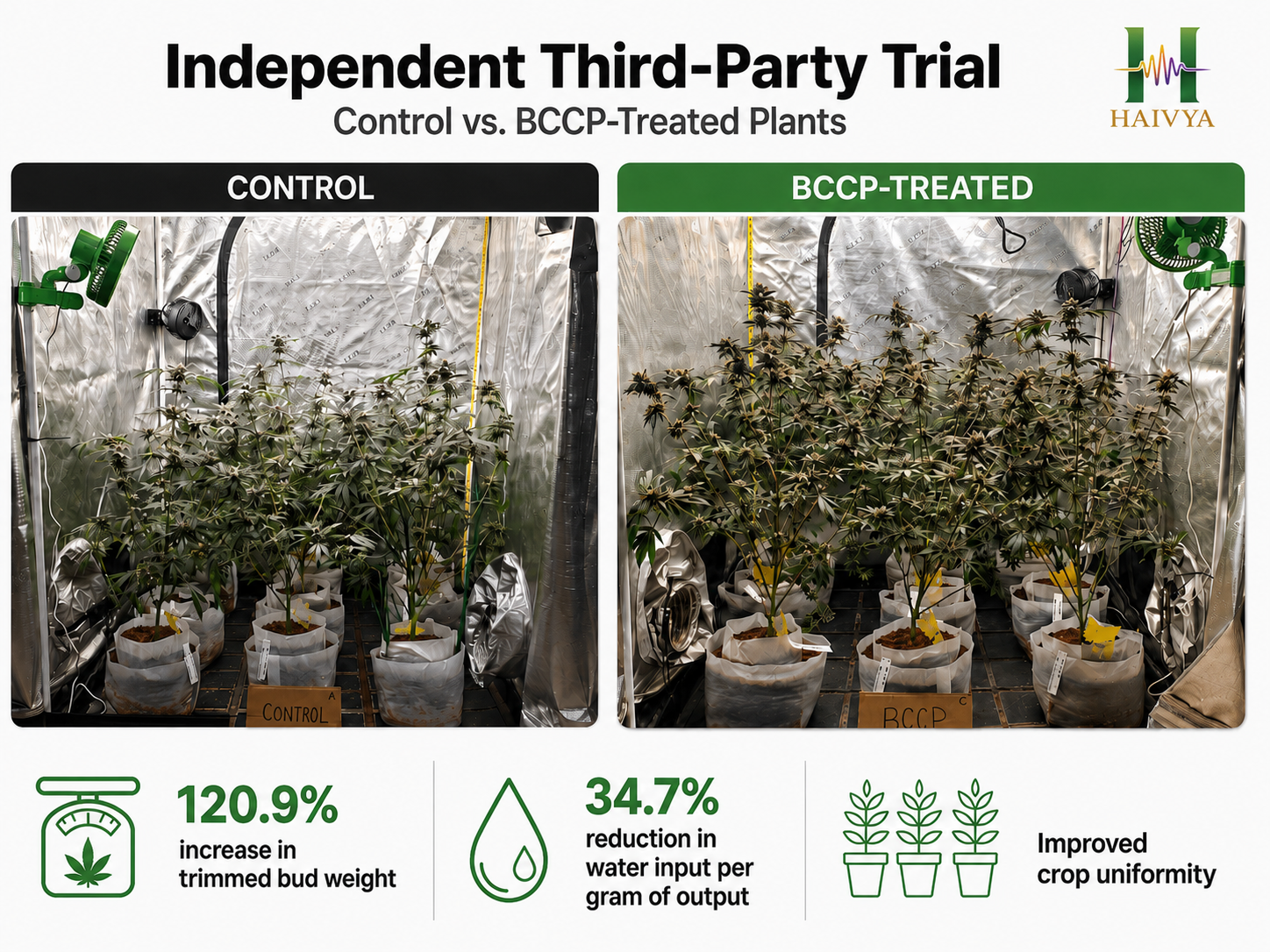
Side-by-side comparison of control plants and BCCP-treated plants from an independent third-party trial, with metrics showing a 120.9% increase in trimmed bud weight, a 34.7% reduction in water input per gram of output, and improved crop uniformity.
Sound-based BCCP protocol shows gains in yield, water efficiency, and crop uniformity without chemicals, genetic modification, or added inputs.
The white paper, authored by Robert Flannery, Ph.D., a UC Davis alumnus and founder of Dr. Robb Farms, reports that BCCP-treated plants produced a 120.9% increase (12.8 grams to 28.2 grams per plant) in trimmed bud weight and a 92.4% increase (30.7 grams to 59.0 grams per plant) in total harvestable dry flower compared with untreated controls in a 36-plant controlled cultivation study.
Conducted from December 2025 through March 2026, the trial was designed around a single treatment variable: exposure to HAIVYA's BCCP acoustic protocol. Cultivation parameters were otherwise held consistently between treated and control groups. Yield was recorded on-site under documented protocols, while cannabinoid and terpene profiles were independently verified by Pure Cannalyst Labs (Irvine, CA), a third-party testing laboratory.
BCCP is not a spray, supplement, seed trait, genetic modification, or chemical growth regulator. It is a phased acoustic protocol that delivers structured sound exposure at defined stages of plant development, designed to engage plant mechanosensory response pathways, including mechanisms plants use to respond to touch, wind, and vibration. BCCP is the subject of a non-provisional application and multiple supporting provisionals covering agricultural applications and the underlying biological approach.
Results reported in the white paper additionally include a 34.7% reduction in water input per gram of output; improved crop uniformity, with coefficient of variation in trimmed bud weight decreasing from 58.8% in controls to 35.6% in BCCP-treated plants; a 57.1% increase in weight per trimmed budsite (354 mg vs. 225mg), with flower-waste-ratio statistically equivalent between groups, confirming dense, proportional floral development without the structural dilution associated with artificially accelerated growth; and 100% of BCCP-treated plants initiating pre-flower development ahead of photoperiod transition compared with 5.6% of controls, a finding Dr. Flannery identifies as a meaningful commercial scheduling advantage for agriculture operators.
Total THC by weight increased 119.5% per plant (7.03g vs. 3.20g), driven primarily by yield gains rather than potency shifts. THC potency remained statistically equivalent between groups (24.90% BCCP vs. 25.05% control), confirming that biomass gains did not come at the expense of phytochemical quality. Terpene analysis revealed a moderate increase in terpene concentration (+4.6%) with selective amplification of pharmacologically significant fractions, notably -Caryophyllene (+22.4%), the only terpene known to act as a dietary cannabinoid through CB2 receptor agonism.
"This is one data point in a pattern we’re seeing consistently across trials and species," said Keston Ott-Dahl, Co-Founder and COO of HAIVYA. "We believe BCCP can become a new input layer for precision agriculture, improving output, water efficiency, and predictability. Our priority now is repeatability across rooms, cultivars, facilities, and plant species."
"The most compelling aspect of the trial was that BCCP appeared to influence multiple commercial metrics at once; yield, water efficiency, and crop uniformity without adding fertilizers, chemicals, genetic modification, or other conventional inputs," said Dr. Flannery. "That combination is what makes this worthy of serious follow-up."
Dr. Flannery's white paper is the first in a broader validation sequence HAIVYA expects to release this summer. Additional work now under way includes a third-party rooting propagation study led by Dr. Alison Justice at an unaffiliated cultivation site in South Carolina, Andrea Ott-Dahl's cross-species BCCP response white paper, and a larger commercial cultivation study under a formal research agreement with Dr. Robb Farms.
The full white paper is available through Haivya's Research & Validation page.
About HAIVYA, Inc.
HAIVYA, Inc. is a Delaware C Corporation developing BCCP, a proprietary patent-pending platform invented by Founder and Chief Scientist Andrea Ott-Dahl, using structured sound exposure to influence plant development, biological output, and resource efficiency. The company is focused on non-chemical, non-genetic tools for precision agriculture, therapeutic cultivation, and plant-based biomanufacturing.
Keston Ott-Dahl
HAIVYA, Inc
+1 925-566-4353
keston@haivya.com
Visit us on social media:
LinkedIn
Legal Disclaimer:
EIN Presswire provides this news content "as is" without warranty of any kind. We do not accept any responsibility or liability for the accuracy, content, images, videos, licenses, completeness, legality, or reliability of the information contained in this article. If you have any complaints or copyright issues related to this article, kindly contact the author above.
