

Atomizing Metal Powder Market Set for Rapid Expansion to USD 6.67 Billion by 2035
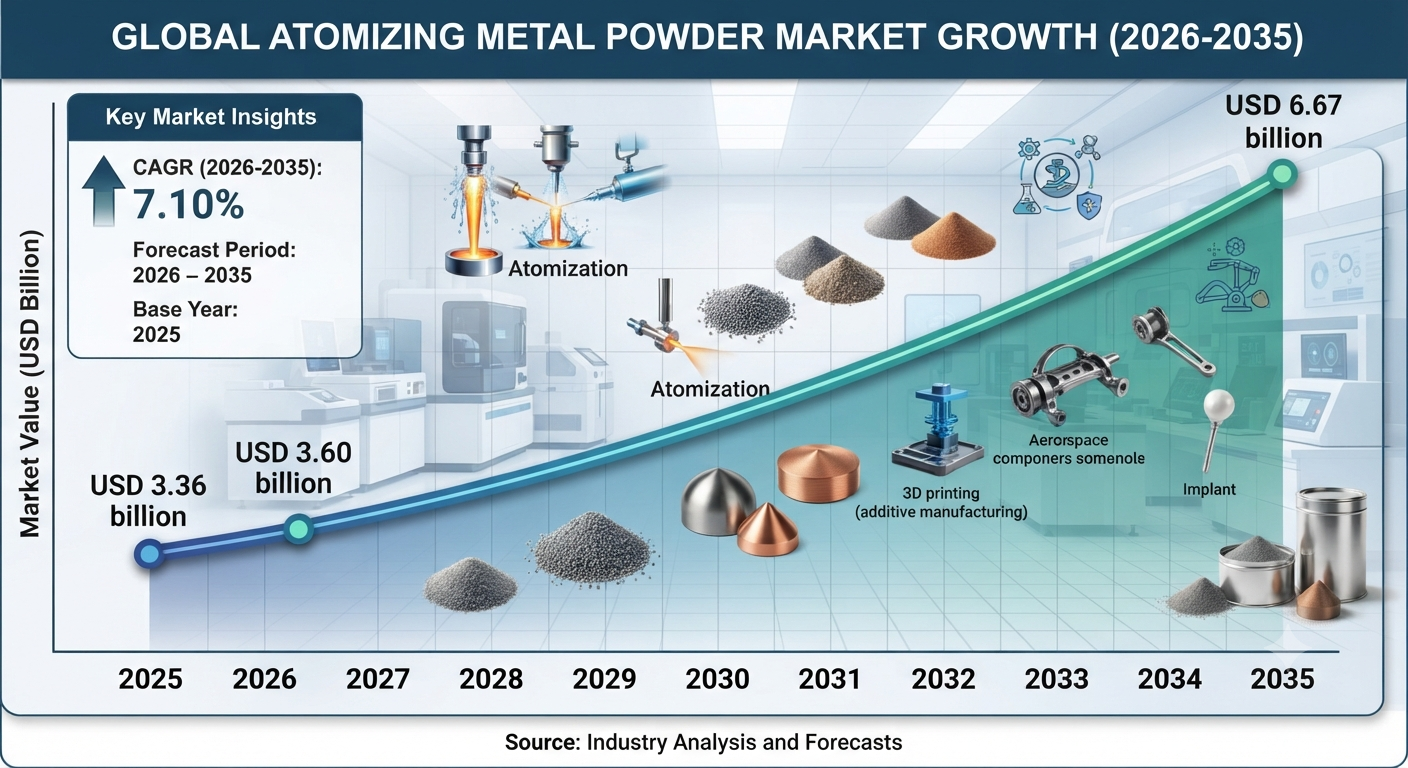
Atomizing Metal Powder Market
What is Atomizing Metal Powder?
Atomizing metal powder is produced by melting metal and then disintegrating the molten stream into fine droplets using a high-pressure fluid (gas or water), which solidify into spherical or irregular powder particles. This process is fundamental to producing feedstock for advanced manufacturing technologies. Key atomization processes include:
Gas Atomization (Largest Segment, 53.1% share): The workhorse process for producing stainless steel and aluminium grades cost-effectively.
Plasma Atomization (Fastest-Growing, 7.36% CAGR): Essential for producing ultra-low-oxygen titanium and superalloy powders for aerospace and medical implants.
Water Atomization: Used for producing iron and tool-steel feedstock where cost is a primary concern.
Get Sample @ https://www.marketresearchfuture.com/sample_request/8521
Market Drivers: The Forces Behind Growth
Several key factors are driving the strong growth of the atomizing metal powder market:
1. Aerospace Qualification Backlog Conversion
The aerospace industry is a major demand anchor. Engine and airframe programmes have accumulated a backlog of qualification packages that are now converting into serial production orders. A single wide-body engine family can lock in 400–600 tons of nickel-superalloy feedstock annually. The rapid increase in NADCAP audit volume signals a pipeline that is now translating into recurring feedstock orders for qualified suppliers.
2. Vehicle Electrification Component Demand
The shift to electric vehicles (EVs) is reshaping the alloy mix. Electric drivetrains require sintered soft-magnetic and aluminium components for rotors, busbar interfaces, and thermal plates, substituting machined castings. With EVs accounting for 22% of global new-car sales in 2024, each percentage point of that shift adds measurable feedstock tonnage, as each traction motor consumes roughly 4–6 kg of iron-based powder.
3. Defence Budget Expansion and Tooling Reshoring
Allied defence procurement is lifting machining and wear-part consumption sharply. The U.S. Department of Defense allocated approximately $1.2 billion across FY2023–FY2025 to domestic titanium and superalloy feedstock capacity, explicitly targeting import substitution. This spending reaches powder suppliers within four to six quarters, providing a short-term demand boost.
4. Medical Implant Clearances
Regulatory throughput for printed titanium and cobalt-chrome devices has accelerated significantly. Each cleared device family commits its manufacturer to a single validated feedstock chemistry, creating high switching costs and protecting incumbent suppliers. Premium pricing on plasma-grade titanium powder makes this the highest revenue-per-kilogram demand pool.
5. Ultra-Low-Oxygen Capacity Build-Out
Suppliers are commissioning atomization cells that hold interstitial oxygen below 300 ppm, a threshold now considered the practical boundary for fatigue-critical parts. This new capacity expands the addressable pool, as several aerospace and implant applications were previously unservable at a commercial scale.
Buy Now @ https://www.marketresearchfuture.com/checkout?currency=one_user-USD&report_id=8521
Market Segmentation: Gas Atomization Leads, Plasma Accelerates
The market is segmented by atomization process, application, and end-user industry, revealing a dynamic landscape.
By The Atomization Process: Gas Leads, Plasma Grows Fastest
Gas Atomization (Largest Segment, 53.1% share): This process dominates due to its cost-per-kilogram advantages on stainless and aluminium grades, making it the workhorse for commercial-scale production.
Plasma Atomization (Fastest-Growing, 7.36% CAGR): This is the fastest-growing process, as aerospace and implant buyers tighten oxygen and satellite-content limits, requiring the superior purity that plasma atomization delivers.
By Application: Additive Manufacturing Leads, Coatings Surge
Additive Manufacturing (Largest Segment, 37.6% share): This is the largest single application pool, driven by the serial certification of airframe, implant, and tooling parts.
Coatings and Thermal-Spray Materials (Fastest-Growing, 7.8% CAGR): This is the fastest-growing application, fueled by demand for turbine-blade repair and extending the life of petrochemical and energy assets.
By End-User Industry: Aerospace Leads, Automotive Surges
Aerospace and Defense (Largest Segment, 30.8% share): This sector absorbs the largest share, requiring ultra-low-oxygen titanium and nickel for engine hardware and structural components.
Automotive and EV Manufacturing (Fastest-Growing, 7.43% CAGR): This is the fastest-growing end-user, driven by light-weighting mandates and the production of traction motor components for EVs.
Regional Insights: Asia-Pacific Leads, North America and Europe Follow
Asia-Pacific: The Largest and Fastest-Growing Region (38.4% share, 8.4% CAGR)
Asia-Pacific dominates the market, supported by Chinese and Indian tooling and battery-component capacity. China's industrial development planning for layered manufacturing set explicit domestic feedstock self-sufficiency targets, while India's growth is the steepest, driven by production-linked incentives.
North America: A Major Market Driven by Defence and Aerospace (27.6% share)
North America holds a significant share, driven by defence feedstock reshoring and engine programme qualification. The United States is the primary contributor, with major players like Carpenter Technology and 6K Additive.
Europe: A Market Driven by Critical Raw Materials Policy (24.1% share)
Europe's demand is policy-shaped, with the Critical Raw Materials Act's 40% domestic processing target pushing buyers toward regional suppliers. Germany and the Nordic countries lead, with a strong focus on turbine superalloys and low-carbon production.
Read More @ https://www.marketresearchfuture.com/reports/atomizing-metal-powder-market-8521
Key Players and Competitive Insights
The market is moderately concentrated, with the top five suppliers holding roughly 38-45% of global revenue.
Höganäs AB (SE): The volume leader with the broadest alloy catalogue, serving iron, stainless, and soft-magnetic composite grades.
Sandvik AB (SE): A purity-led premium producer, focusing on inert-gas stainless, tool-steel, and nickel grades.
GKN Powder Metallurgy (UK): An integrated powder-to-part automotive supplier, dominant in iron and low-alloy steel for sintered components.
Other Key Players: The competitive landscape also includes Carpenter Technology (US), Rio Tinto Metal Powders (CA), JFE Steel Corporation (JP), ATI Inc. (US), and Colibrium Additive (AP&C).
Recent industry developments include significant capacity expansions (Sandvik, Carpenter Technology), a focus on low-carbon production (Höganäs, 6K Additive), and new qualification milestones (PyroGenesis).
Future Outlook: A Core Enabler of Advanced Manufacturing
The atomizing metal powder market is projected to grow at a strong CAGR of 7.10% through 2035. The future will be defined by the continued convergence of process analytics, electrification, and sustainability. Key opportunities lie in:
Localised capacity in emerging industrial economies: First movers can lock in multi-year offtake before incumbents build out local presence.
Feedstock lifecycle data as a revenue line: Packaging lot chemistry and traceability data into a subscription service increases switching costs.
Copper and refractory grades for thermal management: Serving hypersonic and directed-energy programmes with high-value feedstock.
Low-carbon powder premiums: Producers with renewable-powered melt cells can charge premiums on verified low-carbon lots.
As industries demand higher performance, lighter weight, and greater sustainability, atomizing metal powder will remain a critical, high-growth enabling material.
Browse More Reports:
Automotive paint Market https://www.marketresearchfuture.com/reports/automotive-paint-market-22079
Copper Copper Alloys Market https://www.marketresearchfuture.com/reports/copper-copper-alloys-market-41353
acetophenone market https://www.marketresearchfuture.com/reports/acetophenone-market-9317
US Rubber Vulcanization market https://www.marketresearchfuture.com/reports/us-rubber-vulcanization-market-17322
US Scale Inhibitors market https://www.marketresearchfuture.com/reports/us-scale-inhibitors-market-17665
US Soy Based Chemicals market https://www.marketresearchfuture.com/reports/us-soy-based-chemicals-market-14717
fabricated metal product market https://www.marketresearchfuture.com/reports/fabricated-metal-product-market-35782
foundry chemicals market https://www.marketresearchfuture.com/reports/foundry-chemicals-market-22769
Market Research Future
Market Research Future
+1 855-661-4441
email us here
Legal Disclaimer:
EIN Presswire provides this news content "as is" without warranty of any kind. We do not accept any responsibility or liability for the accuracy, content, images, videos, licenses, completeness, legality, or reliability of the information contained in this article. If you have any complaints or copyright issues related to this article, kindly contact the author above.
